This page documents earlier engineering work. This complete system is not offered as a self-serve product. Explore the available engines.
EXTENDED FACE DETECTOR
Brief introducton
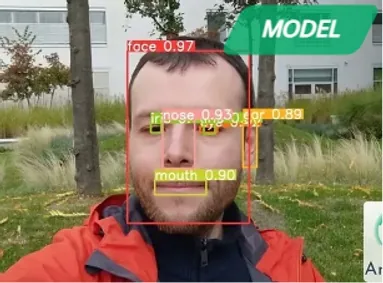
This model can detect face, eye, iris, ear, nose, mouth and even glasses. It is based on a YoloV6 nano, which provides high speed (170+ FPS).
Number of classes: 7 (face, eye, iris, ear, nose, mouth, glasses)
System requirements: Inference time using CPU: 15 ms (on HP Laptop 15-DA0042NH (Processor: Intel(R) Core(TM) i7-8550U CPU)) - Up to 5 ms on GPU (GeForce 1050 TI)
Model description: I made a yolov6 nano object detection model. This model is basically a face detector, but besides the face it can detect sunglasses, eyes, mouth, nose and even iris and ears. I have called this detector an extended face detector, as the detection is extended with the classes mentioned above.
The advantages of this solution are:
-
Very fast, on Nvidia 1050 the inference time is around 5 ms.
-
The inference time is quite good even on CPU, using opencv on an Intel(R) Core(TM) i7-8550U CPU the inference time is 15 ms.
-
It's small and fast enough to run at a reasonable speed on mobile devices.
-
It immediately returns regions of the face, so for simpler usecase it is not necessary to run a separate landmark detector on the face.
Some problem that can be solved with the help of this model:
-
It is capable of detecting multiple parts of the head, so simple head gaze tracking can be achieved using solvepnp.
-
It can also detect the iris, so simple eye gaze tracking can be built on top of it.
-
It gives back a bounding rectangle to the eye, which can be used to implement blink detection.
-
It gives back a bounding rectangle to the mouth, which can be used to implement yawn detection.
-
Since it also detects ears, it is detectable if the ear is covered by something. (This could be a valid usecase for driver monitoring related development.)